Perineal massage & pushing preparation
A guide to preparing the perineum and pelvic floor for vaginal birth. Start this program only after your physical therapist or maternity provider has cleared you.
Why we do this
The perineum is the area of tissue between the vaginal opening and the anus. During birth it has to stretch a great deal in a short period of time.
Regular perineal massage in the final weeks of pregnancy helps that tissue lengthen gradually, and it teaches your nervous system to allow a stretch that would otherwise feel alarming. Practicing pushing mechanics alongside the massage means that on the day of birth the coordination is already familiar.
When to start and how often
First vaginal birth
Weeks 34 to 35. Begin perineal massage at 34 to 35 weeks gestation — 2 sessions per week, about 10 minutes each.
More is not better here. Increasing the frequency does not improve outcomes, and the people who massaged most often tended to have the longest second stage of labor.
Previous vaginal birth
More is helpful here. If you have given birth vaginally before, greater frequency of massage was associated with less pain — the main benefit in this group is decreased perineal pain at three months postpartum, rather than a change in tearing.
Your therapist will set your specific frequency based on your history and any prior tearing or scarring.
Do not begin — and stop if any of these apply
- Incompetent or insufficient cervix
- Ruptured membranes — meaning your water has broken
- Vaginal bleeding at any point in pregnancy
- You have been placed on pelvic rest
- Active vaginal infection or any open lesion or sore
If any of these develop after you have started, stop the massage and contact your maternity provider before doing it again. Also stop and call if you notice new fluid leakage, bleeding, fever, unusual discharge, or regular contractions during or after a session.
How to do the perineal massage
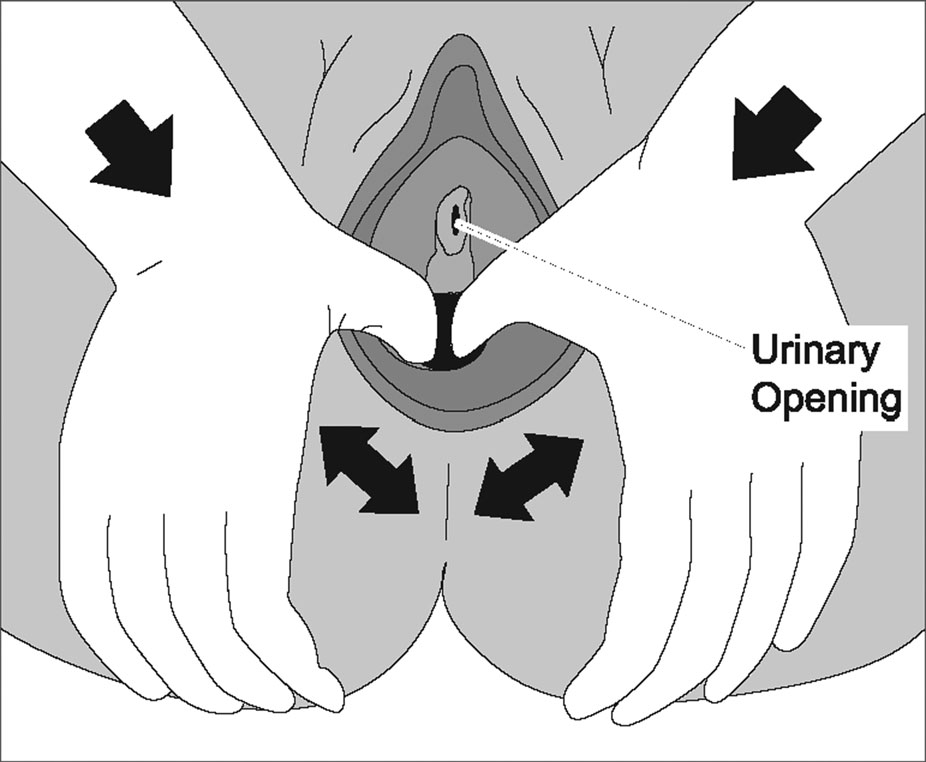
1 · Set up
Empty your bladder, wash your hands well, and make sure your fingernails are short. A warm shower or a warm compress on the perineum for a few minutes beforehand makes the tissue more willing to stretch.
Settle into a private place where you can rest with your legs open and knees bent. Some women like to lean back on pillows for back support. Use a mirror the first few times so you can see what you are working with.
2 · Coat your thumbs
Lubricate your thumbs and the perineal tissues. Good options: vitamin E oil, coconut oil, almond oil, any vegetable cooking oil such as olive oil, a water-soluble jelly such as K-Y, or your body's natural vaginal lubricant. Do not use baby oil, mineral oil, or petroleum jelly (Vaseline).
3 · Place your thumbs
Place your thumbs about 1 to 1.5 inches inside your vagina, resting just inside the vaginal opening. Aim the pressure down and out, never up toward the urinary opening shown in the picture above.
4 · Hold the stretch
Press down toward the anus and out to the sides until you feel a slight burning, stretching sensation. Hold that stretched position for 1 to 2 minutes.
5 · Sweep
With your thumbs, slowly massage the lower half of the vagina using a U-shaped movement, for 2 to 3 minutes at most. Concentrate on relaxing your muscles. This is a good time to practice slow, deep breathing.
6 · Keep it gentle
Do not stretch until it hurts, and do not massage more than once or twice a week. More often does not lower the risk of tearing and can irritate the skin. If you think your water may be leaking, do not put anything in your vagina; check with your provider first.
If a partner is helping: your partner follows the same instructions but uses the index fingers instead of thumbs, with the same side-to-side, U-shaped, downward pressure. Communication matters most: tell them right away if you feel too much pain or burning.
What it should — and should not — feel like
A strong stretch, tingling, or mild burning is expected, especially in the first few sessions. That sensation typically eases as the weeks go on. Sharp pain, pain that lingers after you stop, or any bleeding is not expected. Ease off the pressure, and if it happens again, stop and tell your therapist.
Pushing preparation, starting at 37 weeks
From 37 weeks onward, add a short daily practice of light pushing. The point is not to push hard — it is to rehearse the coordination of breath, deep abdominal muscles, and pelvic floor so that it is automatic in labor.
1 · Learn the pattern
Exhale slowly while gently drawing in the lower abdomen and, at the same time, letting the pelvic floor bulge downward and outward. The pelvic floor drops and opens. It does not squeeze or lift.
2 · Use cues that help
Push out the perineum, as though passing gas. Imagine your sitting bones moving away from each other. Let the perineum bulge downward into your hand or the chair. Soften the jaw and let the breath out rather than bracing against it.
3 · Practice the release first
Practice releasing and letting go before you add any pushing effort. This downtraining is the foundation, so spend time here first.
4 · Add light pushing
A few gentle repetitions daily using the exhale pattern above. Light effort only, roughly two or three out of ten.
5 · Rotate positions
Rehearse in the positions you may actually use in labor: side-lying, hands and knees, supported squat, semi-reclined, and standing with support.
6 · Keep it light
Do not bear down with maximal force, and do not hold your breath and strain. If you feel pressure that does not settle, notice any leaking, or have contractions that continue after you stop, end the session and tell your provider.
Your weekly plan
- 34 to 35 weeks: begin perineal massage, 2 times per week for about 10 minutes. Continue pelvic floor release practice.
- 37 weeks onward: continue perineal massage as above and add light pushing practice daily in varied positions.
- Every session: warm the tissue first, breathe out through the stretch, and stop for sharp pain, bleeding, or fluid leakage.
This handout is patient education and does not replace individualized medical advice. Follow the specific instructions given by your physical therapist and your maternity provider, and contact them with any questions about whether this program is appropriate for you.
Selected references
- Beckmann MM, Stock OM. Antenatal perineal massage for reducing perineal trauma. Cochrane Database Syst Rev. 2013. PMID 23633325.
- Share With Women: Perineal massage in pregnancy. J Midwifery Womens Health. 2017;62(4). doi:10.1111/jmwh.12427.